
Most people who reach out to me have already done some research on Durham. They’ve looked at home prices, maybe watched a few YouTube videos, and Googled the schools. But there’s a whole layer of this city that doesn’t show up in a quick search — the kind of context that actually helps you decide if Durham is right for you and, if it is, where within it you belong.
I moved here from the Bay Area without knowing any of this. I had to learn it the slow way. So consider this the guide I wish someone had handed me when I first arrived.
If you want to explore whether Durham is the right fit for your life specifically, the Find Your Durham Fit quiz is a good place to start.
1. Durham Has Four Nicknames — and Each One Tells You Something Real
Durham wears a lot of hats, and each one shaped a different layer of the city you see today. Understanding these nicknames helps explain why Durham feels nothing like Raleigh or Chapel Hill.
Bull City came from the Blackwell Tobacco Company in the late 1800s. They sold their blend with a bull on the package, and the name stuck. Those old tobacco warehouses downtown are now condos, breweries, and restaurants — which is honestly one of my favorite things about this city. The history didn’t get bulldozed. It got repurposed.
City of Medicine is Duke’s contribution. Duke University Medical Center became one of the top healthcare campuses in the country, and UNC Health, Duke Regional, and the VA Medical Center all anchor the city’s healthcare system. Around 80,000 people work in education and health services across the Triangle — a fact that matters a lot when my clients ask about job stability.
Tastiest Town in the South is a Southern Living designation Durham earned a few years back, and the food scene has only grown since then. Chefs have been leaving New York and Chicago to open restaurants here. Dame’s Chicken and Waffles, NanaSteak, Pizzeria Toro — the list keeps getting longer and better.
Silicon Triangle is the newest nickname. The tech corridor anchored by Research Triangle Park draws companies like IBM, Epic Games, Oracle, Google, and Microsoft. Pfizer, GSK, and Merck add the biotech layer. More than 60,000 people work in tech across the region right now, which is a big reason so many of my clients from the Bay Area feel right at home here almost immediately.
2. Durham Splits Into Four Distinct Areas
When I start working with a new buyer, one of the first things I do is explain how Durham actually divides geographically. It matters more than people expect. Two houses at the same price point in different parts of Durham can offer completely different daily lives.
North Durham feels older and more rural. Lots are larger, and mature trees and wooded backyards are common. About 30% of homes that sold here last year were on septic and well water — something buyers coming from cities often don’t expect. If space and quiet are what you’re after, North Durham delivers. Just go in with eyes open about the infrastructure.
South Durham reads more like Raleigh. This is where most of the planned subdivisions and big-box stores live. The Streets at Southpoint mall is here, along with easy access to grocery stores and restaurants. For dual-commuter households, South Durham is often the practical choice — Interstate 40 puts both Raleigh and Chapel Hill within easy reach.
East Durham is where most of the new construction is happening right now. About 60% of recent new builds in Durham went up on this side of town. Brier Creek shopping sits right on the Durham and Raleigh line, which makes everyday errands easy.
Central and Downtown Durham are what most people picture when they think of Bull City — the historic neighborhoods, the converted tobacco warehouses, the lofts and condos and walkable streets. This is where the food, the breweries, and the arts scene cluster. It’s also where you feel the city’s energy most clearly.
3. Black Wall Street and Durham’s Hayti District
This is the part of Durham’s story I always make sure new residents know, because it’s one of the things that makes this city unlike anywhere else in the Triangle.
In the early 1900s, Durham became home to what people called Black Wall Street. A stretch of downtown businesses owned and run by Black entrepreneurs grew into a national landmark — the wealthiest African American business district in the country at the time.
John Merrick is the name to know. He founded the North Carolina Mutual Life Insurance Company in 1898, which eventually became the largest Black-owned insurance company in the country. He also helped found Mechanics and Farmers Bank in 1907. M&F Bank is still operating today, more than a century later.
The Hayti District was the cultural center of this story. North Carolina Central University, founded in 1910 by James E. Shepard, grew out of this same period. NCCU is one of the oldest historically Black universities in the country and a living part of Durham’s identity today.
Modern Durham works to preserve and celebrate this history. The Hayti Heritage Center hosts events, exhibits, and the annual Bull Durham Blues Festival. When I moved here, learning this history was one of the things that helped me understand why Durham has the soul it does. If you move here, you’re moving to a city with a uniquely American story — and one that takes that story seriously.
4. Durham’s Tech and Biotech Job Market
This comes up on almost every relocation call I have with clients from the Bay Area, Austin, or DC. The short version: if you work in tech, life sciences, or clean energy, the Triangle is one of the strongest job markets in the country right now.
Below the headline employers — IBM, Epic Games, Oracle, Google, Microsoft — the talent pool runs deeper than most people expect. The region has more than 7,000 companies across the Piedmont area.
Cleantech has become a quiet powerhouse. About 27,000 people in the area work for companies like Strata Solar, Delta Products, and Triliant. Triliant actually moved its global headquarters from Silicon Valley to Durham in 2017 — which tells you something about which direction the momentum is moving. Advanced manufacturing employs another 13,000 people locally, with 3M, GE Aviation, and Caterpillar all nearby. Life sciences add another 24,000 jobs across the region.
For relocating buyers, what this means practically is that if your career changes or your partner needs to find work, you’ll have real options within a short drive. Apple’s RTP campus is also bringing thousands more jobs to the region over the next few years, which is something I keep an eye on for clients thinking about long-term growth.
5. What “City of Medicine” Actually Means for Your Family
Calling Durham the City of Medicine sounds like a marketing slogan until you actually live here and need to use the healthcare system. Duke University alone employs more than 43,000 people, making it one of the largest employers in the entire state. But the more important thing for families isn’t the employment numbers — it’s the depth of care available.
Duke Children’s Hospital handles complex pediatric cases that families travel across the country for. Families also turn to the Duke Cancer Institute, one of the top cancer treatment centers in the Southeast. Specialty care options like the Duke Heart Center, Duke Eye Center, and Duke Sports Medicine further strengthen the region’s medical reputation. For clients who are relocating with kids or aging parents, or who have existing health conditions, this depth of specialized care is often a deciding factor.
Patients with rare or hard-to-treat conditions sometimes relocate here specifically for access to the doctors and clinical trials at Duke. More than a few people retiring to the area have told me this was one of the main reasons they chose Durham over other Triangle cities.
6. Durham Schools: What to Know Before You Start House Hunting
Education is one of the most common reasons people reach out to me, and the school picture in Durham is more layered than most people expect. The mix of public, private, magnet, and charter options is wider here than in most other Triangle cities — which is both a strength and something that requires planning.
Higher education is anchored by Duke University, consistently ranked among the top ten universities in the country. Beyond Duke, Durham has 12 colleges and universities total, including North Carolina Central University.
The North Carolina School of Science and Mathematics deserves a special mention. It’s a public boarding high school for juniors and seniors, and it ranks as the top public high school in the state. Students from across North Carolina apply each year.
Durham Public Schools serves K-12 students with a strong mix of magnet, traditional, and charter options. A few schools that come up often in my conversations with families include Pearsontown Elementary, Easley Elementary, Burton Elementary, Rogers-Herr Middle, Lakewood Montessori Middle, Durham School of the Arts, and J.D. Clement Early College High School.
Here’s the part new families often don’t see coming: Durham has a high concentration of charter schools, and the lottery process for magnets and charters is its own learning curve. My strong advice is to start your school research at the same time you start your house search — not after you’ve already made an offer.
7. What to Do, Eat, and Explore in Durham
This is where I could talk for hours. Durham packs more into its size than most cities I know, and the downtown alone has enough to fill a few good weekends.
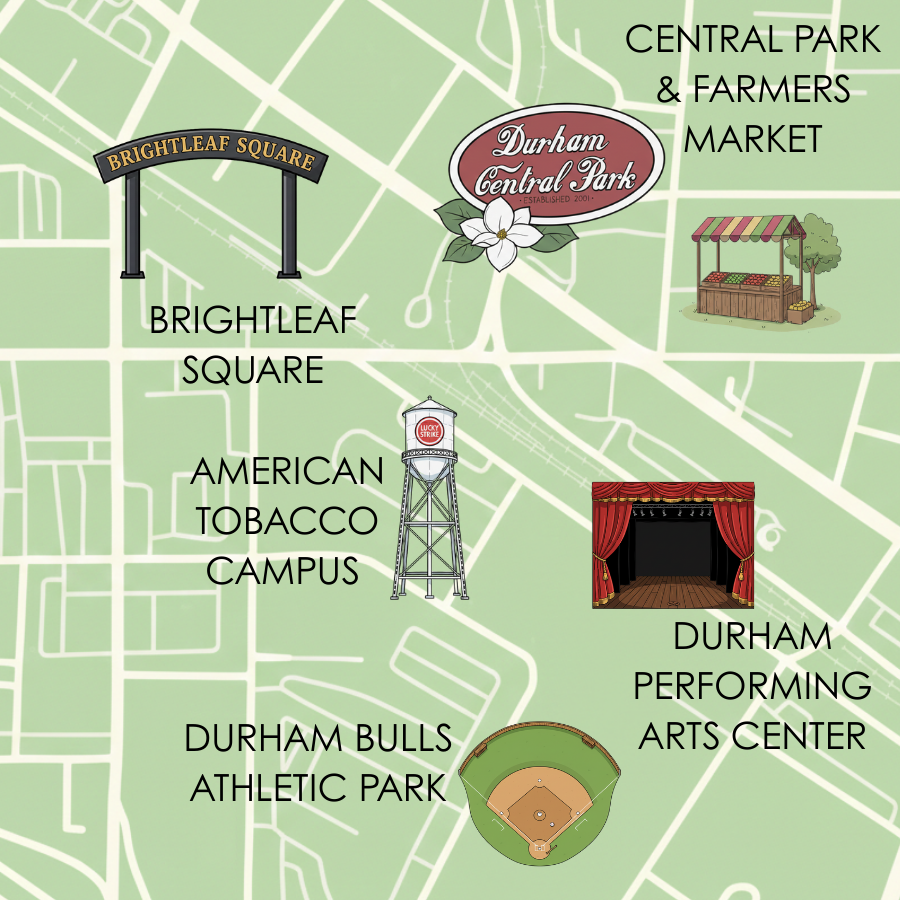
For entertainment and arts, the Durham Performing Arts Center is the headliner — DPAC books Broadway tours, big-name concerts, and comedy acts year round. The Carolina Theatre is the older, more intimate option for movies, festivals, and live music. The Nasher Museum of Art on Duke’s campus rotates strong exhibitions, and the 21c Museum Hotel doubles as a working contemporary art gallery right downtown.
The food scene is the thing I hear about most from people who visit before moving. American Tobacco Campus is the converted tobacco district where a lot of weekend dinners start. Boricua Soul does Puerto Rican and Caribbean food. Ekhaya brings South African flavors. Mescalito is the Mexican spot downtown locals talk about. Durham Food Hall keeps about a dozen vendors under one roof — which is where I usually take people on their first visit, because it gives you a fast, honest look at how the city eats.
For families, Sarah P. Duke Gardens covers 55 acres on the Duke campus and draws over 600,000 visitors a year. The Duke Lemur Center houses more than 200 lemurs and is genuinely one of the coolest things about living here. The Museum of Life and Science is the go-to spot for families with young kids. And Boxyard RTP is a newer outdoor food and shopping space tucked inside Research Triangle Park that’s worth knowing about.
For shopping, Brightleaf Square mixes restaurants and boutiques inside historic warehouse buildings. The Streets at Southpoint is the main mall — Nordstrom, Apple, Peloton, and more. Ninth Street, just outside Duke, has indie bookstores, coffee shops, and small businesses that make for a good Saturday afternoon.
8. Outdoor Life in Durham
For a city this size, Durham has surprisingly good access to the outdoors. Some of it is built right into the city, and some sits just a short drive away.
Eno River State Park is the local favorite, and it was one of the first places I took Isla when she was old enough to explore. It sits about ten miles outside downtown and feels like a completely different world — hiking, fishing, kayaking, and picnic spots along the river. The Mountains-to-Sea Trail runs through it, connecting Durham all the way to the Smokies and the Outer Banks.
Falls Lake State Recreation Area is the bigger draw for water sports. It covers a large area east of Durham, with mountain biking trails, swimming beaches, and boat ramps. The American Tobacco Trail is one of my favorite hidden gems — a 22-mile rail trail running from downtown Durham south to Apex, used by walkers, runners, cyclists, and even horseback riders year round.
Closer to the city, Durham Central Park anchors the downtown weekend scene. The Durham Farmers Market sets up here on Saturdays from spring through fall, and a recent bond funded a new aquatic center with zero-entry pools and a lazy river. For a city this urban, the outdoor options are genuinely strong.
9. Durham Neighborhoods Worth Knowing
This is the question I get most often, and it’s also the one I spend the most time on with every client. Where you live in Durham shapes your daily life in ways that a price tag alone won’t tell you.
A few neighborhoods come up on almost every relocation call I have. Downtown Durham is the loft and condo zone — converted tobacco warehouses make up much of the housing stock, and walkability here is the strongest in the city. Trinity Park is a tree-lined historic neighborhood next to Duke, with early 20th-century homes and consistently strong demand. Brightleaf mixes condos, apartments, and a few historic homes near the action of the Brightleaf District.
Hope Valley is one of the larger suburban-style neighborhoods, with bigger homes and quick access to RTP — popular with my clients who are commuting regularly. Woodcroft offers newer planned-community housing and draws a lot of buyers who work in the park. Forest Hills is a quieter pocket near central Durham with strong tree cover and a more tucked-away feel. Old West Durham sits next to Duke and blends bungalows, newer infill, and walkable streets in a way that a lot of my clients from coastal cities find immediately appealing. Old North Durham mixes restored homes with active renovation projects just north of downtown. And Walltown and Trinity Heights are emerging neighborhoods with more accessible price points and short commutes downtown — worth watching if you’re earlier in your budget range.
The most important thing I can tell you about Durham neighborhoods is that you can’t pick one from a map. Each area feels different at different times of day, in different seasons, and depending on how you actually live. That’s why I always recommend spending real time in a neighborhood before committing to it.
Ready to start narrowing down which part of Durham fits your life? I’d love to help you think it through. Let’s get you settled.


